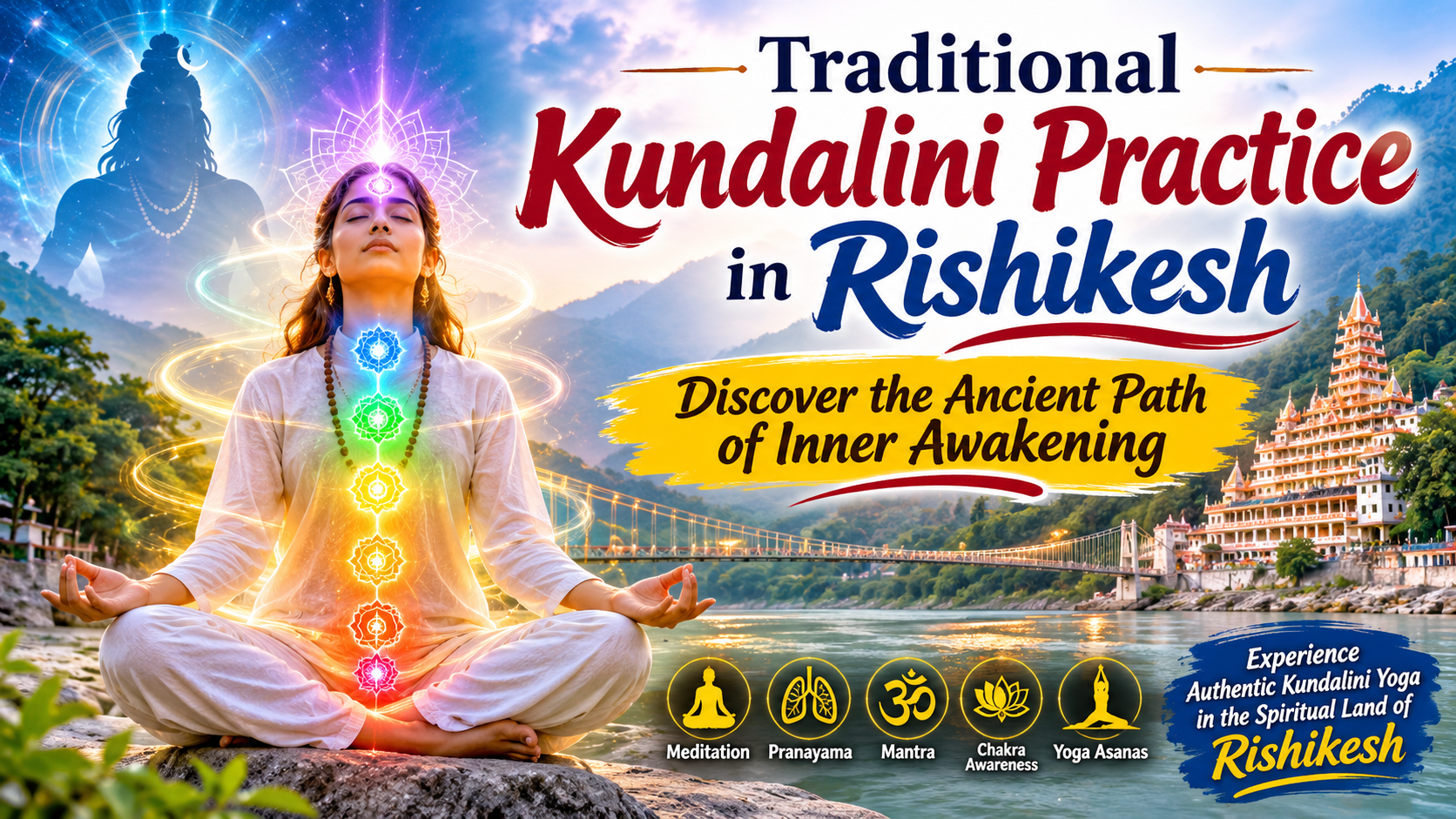
Traditional Kundalini Practice in Rishikesh: Discover the Ancient Path of Inner Awakening
Rishikesh, famously known as the Yoga Capital of the World, has been a centre of spiritual learning, meditation, and traditional yogic practices for centuries. Situated along the sacred banks of the River Ganga and surrounded by the peaceful Himalayan foothills, this spiritual destination attracts seekers from across the world who wish to explore the deeper dimensions of yoga and self-awareness.
Among the many spiritual traditions practised here, Traditional Kundalini Practice in Rishikesh holds a special place. Rooted in ancient yogic philosophy, Kundalini Yoga focuses on developing awareness, balancing the body and mind, and exploring the subtle dimensions of human consciousness.
Unlike modern fitness-oriented yoga routines, traditional Kundalini practice follows a more holistic approach that may include meditation, pranayama, mantra, asana, concentration, and guidance from an experienced teacher.
Whether you are a beginner, a regular yoga practitioner, or someone interested in traditional Indian spirituality, Rishikesh offers an inspiring environment to understand and experience the traditional approach to Kundalini Yoga.
What Is Traditional Kundalini Practice?
Traditional Kundalini practice is an ancient yogic approach associated with the concept of Kundalini Shakti, often symbolically described in yogic traditions as a dormant spiritual energy located at the base of the spine.
According to traditional yogic philosophy, through disciplined practice, self-awareness, meditation, breath regulation, and spiritual guidance, practitioners gradually develop a deeper understanding of their inner nature.
The purpose of traditional Kundalini practice is not simply physical flexibility or fitness. It is a holistic journey involving:
- Developing mental concentration and awareness.
- Cultivating inner peace and emotional balance.
- Understanding the relationship between breath and mind.
- Exploring the traditional chakra system.
- Practising meditation and self-observation.
- Developing discipline and spiritual understanding.
Traditional Kundalini Yoga encourages a gradual approach rather than rushing towards extraordinary experiences. Consistency, patience, and proper guidance are important elements of the practice.
Why Choose Rishikesh for Traditional Kundalini Practice?
Rishikesh is one of India’s most recognised destinations for traditional yoga and meditation. Its spiritual atmosphere, ancient temples, ashrams, Himalayan surroundings, and connection with the River Ganga create an environment that many practitioners find supportive for inner exploration.
There are several reasons why people choose Rishikesh to learn traditional Kundalini Yoga.
1. Deep Connection with Ancient Yogic Traditions
Rishikesh has a long association with Indian spiritual traditions. Generations of yogis, saints, and spiritual teachers have visited and practised meditation in this region.
Learning Kundalini Yoga in Rishikesh gives practitioners an opportunity to explore traditional yogic philosophy alongside practical techniques.
2. Peaceful Environment for Meditation
A peaceful environment can make it easier to develop concentration and establish a regular meditation routine.
The natural surroundings of Rishikesh, including the Ganga River and Himalayan landscape, offer an atmosphere that encourages reflection, simplicity, and mindfulness.
3. Guidance from Experienced Yoga Teachers
Traditional Kundalini practices require an understanding of yogic principles and appropriate preparation.
Learning under an experienced teacher can help practitioners understand breathing techniques, meditation methods, body awareness, and the importance of a balanced approach.
4. Authentic Spiritual Learning
Many visitors come to Rishikesh not only to learn yoga postures but also to understand the spiritual philosophy behind yogic practices.
Traditional Kundalini Yoga provides an opportunity to explore meditation, chakras, mantras, pranayama, and the connection between body, breath, and consciousness.
Important Elements of Traditional Kundalini Yoga
Traditional Kundalini practice is not limited to one particular technique. It involves different yogic disciplines that work together to develop awareness and a balanced approach to spiritual practice.
1. Pranayama – Understanding the Power of Breath
Pranayama refers to traditional yogic breathing practices. Breath awareness plays an important role in preparing the mind and body for meditation.
Some commonly known breathing practices include:
- Nadi Shodhana (alternate nostril breathing)
- Bhramari Pranayama
- Gentle breath awareness
- Traditional breath regulation techniques
These practices are generally introduced according to the practitioner’s experience and comfort level.
2. Chakra Meditation – Exploring the Energy Centres
Chakra meditation is an important subject in many traditional yogic teachings.
According to yogic philosophy, the human subtle body is described through seven primary chakras:
- Muladhara Chakra: Associated with stability and grounding.
- Swadhisthana Chakra: Associated with creativity and emotions.
- Manipura Chakra: Associated with confidence and personal power.
- Anahata Chakra: Associated with compassion and love.
- Vishuddha Chakra: Associated with communication and expression.
- Ajna Chakra: Associated with concentration and inner insight.
- Sahasrara Chakra: Associated with spiritual awareness and transcendence.
Chakra meditation encourages practitioners to develop concentration and explore these traditional concepts through mindful observation.
3. Mantra Meditation – The Role of Sacred Sound
Mantra meditation is another important element of traditional Indian spiritual practice.
A mantra is a sacred sound, word, or phrase repeated with concentration and awareness. In yogic traditions, mantras are used as a meditation support to help practitioners maintain focus.
Some commonly practised mantras include:
- Om
- So Hum
- Om Namah Shivaya
- Gayatri Mantra
Mantra meditation can be incorporated into a regular spiritual routine under suitable guidance.
4. Traditional Yogic Asanas
Physical postures help practitioners develop stability, flexibility, and body awareness.
Traditional Kundalini practice may include suitable yoga asanas to prepare the body for pranayama and meditation.
Common postures include:
- Sukhasana (Easy Pose)
- Vajrasana (Thunderbolt Pose)
- Padmasana (Lotus Pose)
- Bhujangasana (Cobra Pose)
- Balasana (Child’s Pose)
The selection of postures depends on individual ability, physical condition, and the teacher’s instructions.
5. Meditation and Inner Awareness
Meditation is one of the central aspects of traditional Kundalini practice.
Through regular meditation, practitioners learn to observe their thoughts, emotions, breathing patterns, and mental reactions without unnecessary judgment.
The objective is to develop a deeper understanding of the mind and cultivate a stable foundation for spiritual growth.
Traditional Kundalini Practice for Beginners in Rishikesh
Many people believe that Kundalini Yoga is only suitable for advanced spiritual practitioners. However, beginners can also explore the foundational aspects of this traditional discipline through an appropriate learning programme.
For beginners, the journey should start with simple and comfortable practices.
A beginner-friendly approach may include:
Step 1: Understanding Yogic Philosophy
Learn the basic principles of Kundalini Yoga, chakras, meditation, and the traditional concept of inner energy.
Step 2: Developing Body Awareness
Practise gentle yoga postures to improve stability, coordination, and awareness of physical sensations.
Step 3: Learning Basic Pranayama
Start with comfortable breathing awareness and simple breathing techniques under proper guidance.
Step 4: Practising Meditation
Develop a consistent meditation routine, beginning with short sessions and gradually increasing the duration.
Step 5: Understanding Spiritual Discipline
Build consistency through mindful living, self-observation, patience, and a balanced daily routine.
Beginners should avoid forcing intense breathing exercises, prolonged breath retention, or attempts to induce Kundalini experiences without qualified supervision.
Difference Between Traditional Kundalini Yoga and Modern Kundalini Classes
The term Kundalini Yoga is used in different ways across the modern yoga world. Some classes focus primarily on physical movements, repetitive exercises, and breathing sequences, while traditional approaches may place greater emphasis on yogic philosophy, meditation, subtle-body concepts, and spiritual discipline.
Here is a general comparison:
| Traditional Kundalini Approach | Modern Fitness-Oriented Approach |
|---|---|
| Emphasis on yogic philosophy | Emphasis on physical routines |
| Meditation and self-awareness | Movement and exercise |
| Traditional chakra concepts | May include selected energy concepts |
| Mantra and concentration practices | May use music and rhythmic sequences |
| Gradual spiritual discipline | Structured fitness sessions |
| Guidance based on individual readiness | Often follows a standard class format |
Both approaches may offer different learning experiences. Understanding their differences helps students choose a practice that matches their interests and expectations.
Understanding the Role of Shaktipat in Kundalini Practice
Shaktipat is a traditional spiritual concept associated with the transmission of spiritual energy or grace through a spiritual teacher, according to certain Indian yogic traditions.
It is discussed in several spiritual lineages and is often connected with the idea of spiritual awakening and inner transformation.
People interested in Shaktipat may wish to understand its philosophical background, traditional significance, and relationship with Kundalini.
However, Shaktipat should not be confused with a guaranteed method of spiritual awakening. Individual experiences differ, and physical sensations such as trembling, warmth, emotional release, or spontaneous movements should not automatically be interpreted as proof of Kundalini awakening.
A responsible spiritual approach emphasises proper guidance, personal well-being, grounding, and gradual development.
Benefits of Practising Traditional Kundalini Yoga
Traditional Kundalini Yoga offers a holistic framework for exploring physical, mental, and spiritual well-being.
With regular and appropriate practice, some potential benefits include:
Improved Mental Concentration
Meditation and breath awareness encourage practitioners to observe their thoughts and improve their ability to focus.
Better Body Awareness
Gentle asanas and mindful movement help individuals understand their posture, breathing patterns, and physical limitations.
Emotional Awareness
Meditation can provide an opportunity to recognise emotional patterns and respond to everyday situations with greater awareness.
Development of Inner Peace
Regular meditation and mindful breathing may support relaxation and a greater sense of calm.
Deeper Spiritual Understanding
Studying Kundalini philosophy, chakra concepts, and traditional yogic teachings can help practitioners explore the spiritual dimensions of Indian yoga.
It is important to remember that experiences and results vary from person to person. Kundalini practice is a spiritual discipline, not a guaranteed treatment for medical or psychological conditions.
What Makes a Traditional Kundalini Yoga Class in Rishikesh Different?
A meaningful Kundalini Yoga learning experience should go beyond simply performing physical movements.
A well-structured traditional class may include:
- An introduction to Kundalini philosophy.
- Understanding the traditional chakra system.
- Guided meditation sessions.
- Appropriate pranayama techniques.
- Gentle yogic postures.
- Mantra and concentration practices.
- Personal guidance and practical instructions.
- Time for reflection and questions.
The quality of teaching, safety, transparency, and the teacher’s understanding of traditional yoga philosophy are important when selecting a Kundalini Yoga programme in Rishikesh.
How to Choose the Right Kundalini Yoga Teacher in Rishikesh
Choosing the right teacher is an important step in your spiritual learning journey.
Before joining a traditional Kundalini Yoga class, consider the following points:
1. Experience and Knowledge: Look for a teacher who understands traditional yogic philosophy and can explain the practices clearly.
2. Individual Attention: Beginners should receive appropriate guidance according to their experience and physical comfort.
3. Balanced Teaching: A responsible teacher should explain the importance of gradual practice instead of promising instant spiritual awakening.
4. Transparent Information: Understand the class structure, teaching methods, duration, and expectations before joining.
5. Safe Learning Environment: Choose a setting where students feel comfortable asking questions and discussing their experiences.
A genuine learning environment should encourage patience, discipline, humility, and self-awareness.
Experience Traditional Kundalini Practice in the Spiritual Environment of Rishikesh
Rishikesh provides a unique setting for people interested in exploring traditional Indian yoga and meditation.
Whether you are visiting from another country or living in Uttarakhand, learning traditional Kundalini Yoga can become an opportunity to understand ancient yogic principles and develop a regular spiritual routine.
From chakra meditation and pranayama to mantra practices and inner awareness, each aspect offers a different perspective on the traditional yogic path.
For beginners, the most important thing is to start with foundational practices and learn at a comfortable pace. For experienced practitioners, studying traditional philosophy and refining meditation techniques can deepen their understanding.
The journey of Kundalini is not about chasing extraordinary experiences. It is about developing awareness, discipline, balance, and a deeper connection with oneself.
Begin Your Traditional Kundalini Yoga Journey in Rishikesh
If you are searching for Traditional Kundalini Practice in Rishikesh, take the opportunity to explore a learning approach rooted in traditional yogic philosophy and spiritual discipline.
Rishikesh offers an inspiring atmosphere to learn meditation, pranayama, chakra awareness, and the deeper principles of Kundalini Yoga.
Whether you are a beginner or an experienced yoga enthusiast, approach the practice with patience, curiosity, and respect for its traditional teachings.
Discover the traditional path of Kundalini Yoga in Rishikesh and take a meaningful step towards greater self-awareness and inner growth.