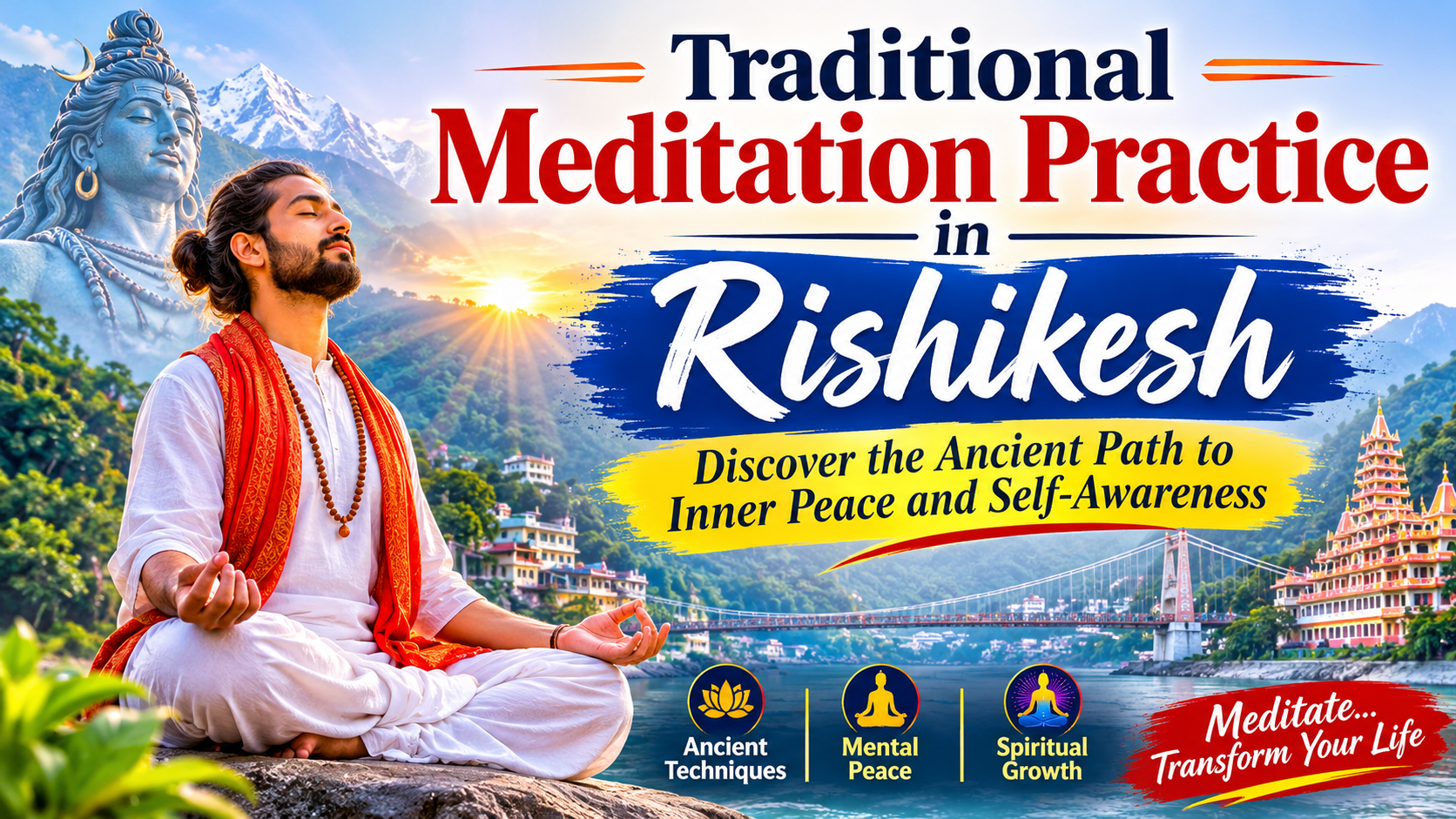
Traditional Meditation Practice in Rishikesh: Discover the Ancient Path to Inner Peace and Self-Awareness
Introduction: Experience the Ancient Tradition of Meditation in Rishikesh
Rishikesh is one of India’s most recognized spiritual destinations, known for its ancient yogic traditions, peaceful Himalayan surroundings, and deep connection with meditation and spirituality. Situated along the sacred River Ganga and surrounded by the foothills of the Himalayas, this beautiful town offers an environment where individuals can explore the traditional practices of meditation and develop a deeper understanding of themselves.
Traditional Meditation Practice in Rishikesh is not simply about sitting quietly with closed eyes. It is a journey of developing awareness, understanding the mind, observing thoughts, and experiencing inner stillness through time-tested meditation techniques. Rooted in ancient Indian wisdom, traditional meditation encourages individuals to bring balance to their thoughts, emotions, breathing patterns, and everyday activities.
Whether you are a beginner, a yoga practitioner, a spiritual seeker, or someone looking for a peaceful break from a busy lifestyle, meditation in Rishikesh provides an opportunity to reconnect with your inner self.
Unlike modern approaches that sometimes focus only on relaxation, traditional meditation explores a broader path involving discipline, self-observation, concentration, mindfulness, and spiritual understanding.
Why Is Rishikesh Famous for Traditional Meditation?
Rishikesh has been associated with yoga, meditation, and spiritual learning for centuries. Spiritual seekers, yogis, and practitioners from different parts of the world visit this destination to learn about India’s traditional spiritual practices.
There are several reasons why Rishikesh is considered a meaningful place to explore meditation.
1. Deep Connection with Ancient Indian Wisdom
Traditional meditation in Rishikesh is influenced by ancient Indian philosophical traditions, including Yoga, Vedanta, and teachings found in classical spiritual texts.
The Yoga Sutras of Patanjali explain the importance of controlling mental fluctuations and developing a focused state of awareness. These teachings provide a foundation for understanding meditation as a systematic practice rather than simply a relaxation exercise.
Students exploring traditional meditation can learn about:
-
Dharana – Developing concentration.
-
Dhyana – Practising meditation and sustained awareness.
-
Pratyahara – Turning attention inward.
-
Mindfulness – Observing thoughts without unnecessary reactions.
-
Self-awareness – Understanding one’s thoughts, behaviour, and inner experiences.
These principles help practitioners understand the deeper purpose of meditation.
2. Peaceful Natural Surroundings
The natural environment of Rishikesh offers a unique atmosphere for meditation. The flowing River Ganga, fresh mountain air, green surroundings, and peaceful landscapes create opportunities to step away from daily distractions.
Many practitioners prefer early morning meditation because the environment is generally quieter and provides a comfortable setting for concentration and self-observation.
Meditating in a peaceful environment can make it easier for beginners to establish a consistent practice.
3. Traditional Yogic Environment
Rishikesh is home to numerous yoga centres, ashrams, meditation schools, and spiritual learning spaces. These places offer opportunities to explore traditional meditation under the guidance of experienced teachers.
A traditional learning environment often emphasizes regular practice, personal discipline, correct posture, breath awareness, and gradual development of concentration.
For people interested in understanding meditation beyond basic relaxation, this environment can provide a valuable learning experience.
Understanding Traditional Meditation: More Than Just Relaxation
Meditation is often misunderstood as a technique for stopping thoughts completely. However, traditional meditation does not necessarily require the mind to become empty.
Instead, it teaches practitioners to observe the natural movement of thoughts without becoming unnecessarily attached to them.
The mind may wander during meditation. This is normal, especially for beginners. The practice involves gently bringing attention back to the chosen object of meditation, such as the breath, a mantra, or a particular point of awareness.
Traditional meditation focuses on developing the following qualities:
Mental Awareness: Understanding how thoughts arise and influence daily behaviour.
Concentration: Training the mind to remain attentive without frequent distractions.
Emotional Balance: Learning to observe emotional experiences with patience and awareness.
Inner Discipline: Developing consistency through regular meditation practice.
Spiritual Understanding: Exploring deeper questions about consciousness, identity, and the nature of the self.
With regular practice, meditation can become more than a daily activity. It can gradually become a way of approaching everyday life with greater awareness.
Popular Traditional Meditation Techniques Practised in Rishikesh
Rishikesh provides opportunities to explore different meditation traditions. Each technique has its own method, purpose, and approach to developing awareness.
1. Breath Awareness Meditation (Anapanasati)
Breath awareness is one of the simplest and most accessible meditation techniques for beginners.
The practitioner sits comfortably and observes the natural flow of breathing. There is no need to force the breath or change its rhythm. The main objective is to develop awareness of inhalation and exhalation.
During this practice, attention may move towards different thoughts, sounds, or sensations. Whenever this happens, the practitioner gently returns attention to the breath.
Benefits of regular practice may include:
-
Improved attention and concentration.
-
Better awareness of breathing patterns.
-
A calmer approach to daily stress.
-
Greater understanding of the relationship between mind and body.
2. Mantra Meditation
Mantra meditation is an important part of several Indian spiritual traditions. It involves repeating a sacred sound, word, or mantra with attention and awareness.
Mantras such as Om are commonly used in traditional meditation practices.
The repetition may be performed mentally or verbally, depending on the method being taught.
Mantra meditation encourages practitioners to maintain a consistent point of focus. It can also help create a meaningful connection with traditional spiritual teachings.
For many spiritual seekers, mantra meditation is not only a concentration technique but also a way of deepening their devotional practice.
3. Vipassana Meditation
Vipassana is a traditional meditation practice that emphasizes insight and direct observation of experiences.
Practitioners observe bodily sensations, thoughts, emotions, and mental reactions without immediately judging or reacting to them.
The objective is to develop a clearer understanding of how experiences arise and change.
Vipassana meditation encourages patience, awareness, and a balanced attitude towards pleasant and unpleasant experiences.
It is particularly valuable for individuals interested in exploring mindfulness and self-observation.
4. Chakra Meditation
Chakra meditation is associated with traditional yogic and tantric systems that describe subtle energy centres within the human body.
In many traditions, seven primary chakras are discussed, beginning with the Muladhara Chakra and extending to the Sahasrara Chakra.
Practices may involve concentration, visualization, mantra repetition, and awareness of different energy centres.
The seven commonly discussed chakras are:
| Chakra | Traditional Sanskrit Name | Associated Theme |
|---|---|---|
| Root Chakra | Muladhara | Stability |
| Sacral Chakra | Svadhisthana | Creativity |
| Solar Plexus | Manipura | Confidence |
| Heart Chakra | Anahata | Compassion |
| Throat Chakra | Vishuddha | Expression |
| Third Eye | Ajna | Intuition |
| Crown Chakra | Sahasrara | Spiritual awareness |
Chakra meditation is often explored by practitioners interested in traditional yogic philosophy, inner awareness, and spiritual development.
5. Dhyana Meditation
Dhyana is one of the central concepts of classical Yoga philosophy.
In Patanjali’s Ashtanga Yoga, Dhyana follows Dharana, which refers to concentration.
While Dharana involves maintaining attention on a chosen object, Dhyana represents a deeper and more continuous flow of attention towards that object.
This practice requires patience and consistency. It is generally developed gradually through regular concentration and meditation exercises.
Dhyana is particularly relevant for spiritual seekers who want to understand meditation as a deeper practice of awareness.
6. Nada Meditation
Nada meditation is associated with awareness of sound, including subtle inner listening in certain traditional practices.
The word Nada refers to sound or vibration. Depending on the tradition, practitioners may focus on external sounds, mantra sounds, or inner auditory experiences.
This approach encourages attentive listening and concentration.
It is important to learn advanced Nada practices under appropriate guidance, especially when they involve specific traditional methods.
Traditional Meditation Practice for Beginners in Rishikesh
If you are new to meditation, starting with simple and structured techniques can make your learning experience more comfortable.
Many beginners believe that meditation requires complete silence of the mind from the first day. This expectation can make the practice unnecessarily difficult.
Traditional meditation encourages gradual development rather than forcing immediate results.
Here is a simple daily meditation routine for beginners.
Step 1: Choose a Peaceful Place
Find a quiet place where you can sit comfortably without frequent interruptions. You can practise indoors, in a meditation hall, or in a peaceful outdoor environment.
Step 2: Sit in a Comfortable Position
Sit on a meditation cushion or yoga mat. Sukhasana is a commonly used cross-legged sitting posture. Keep your spine naturally upright without creating unnecessary tension.
Step 3: Observe Your Natural Breathing
Close your eyes gently and bring your attention towards your breathing. Notice the inhalation and exhalation without trying to control them.
Step 4: Observe Your Thoughts
Thoughts may continue to appear. Instead of fighting them, simply notice them and return your attention to your chosen meditation object.
Step 5: Practise Consistently
Begin with 5–10 minutes of meditation. Gradually increase the duration as your comfort and concentration improve.
Step 6: Finish with Awareness
After completing the practice, slowly bring your attention back to your surroundings. Take a few comfortable breaths before continuing with your daily activities.
A regular and realistic routine is generally more useful than practising for long periods without consistency.
The Importance of a Spiritual Teacher in Traditional Meditation
Traditional meditation has historically been transmitted through teacher-student relationships. In Indian spiritual traditions, a Guru may guide a student through different stages of learning and spiritual practice.
A knowledgeable meditation teacher can help practitioners understand the purpose of specific techniques, correct common mistakes, and develop a suitable routine.
The guidance of a teacher can be especially valuable when exploring advanced practices involving mantra, chakra awareness, pranayama, or deeper concentration.
A traditional teacher may emphasize:
-
Understanding the philosophy behind meditation.
-
Developing discipline and consistency.
-
Learning appropriate meditation postures.
-
Practising breath awareness correctly.
-
Maintaining a balanced approach towards spiritual experiences.
-
Integrating meditation into everyday life.
However, beginners should remember that meditation is a gradual process. There is no need to compare personal experiences with those of other practitioners.
Traditional Meditation vs Modern Meditation: Understanding the Difference
Meditation is practised in many different ways today. Some modern approaches focus mainly on stress management, relaxation, and improving concentration, while traditional meditation often includes philosophical and spiritual dimensions.
Both approaches can be valuable, depending on an individual’s interests and goals.
| Traditional Meditation | Modern Meditation |
|---|---|
| Rooted in ancient spiritual and yogic traditions | Often influenced by contemporary wellness practices |
| May include mantra, Dhyana, and self-inquiry | Often includes mindfulness and relaxation |
| Emphasizes spiritual understanding and awareness | Frequently emphasizes mental well-being |
| Can involve traditional philosophy and discipline | Often adapted for everyday lifestyles |
| May be taught through a Guru-student relationship | Often taught through apps, courses, or instructors |
Traditional meditation does not exclude relaxation or mental well-being. Rather, it places these experiences within a broader framework of self-awareness and spiritual understanding.
Benefits of Practising Traditional Meditation Regularly
Meditation is a practice that develops through consistency. Although individual experiences vary, research and traditional teachings both recognize several potential benefits associated with regular meditation.
1. Improved Mental Focus
Concentration-based meditation trains the mind to return to a chosen object of attention. Over time, this practice may help individuals become more aware of distractions and improve their ability to focus.
2. Better Stress Management
Meditation offers an opportunity to pause, observe thoughts, and respond more thoughtfully to challenging situations.
Regular practice may support stress management and emotional well-being.
3. Greater Self-Awareness
One of the important aspects of traditional meditation is learning to observe your own thoughts, emotions, and behavioural patterns.
This awareness can help individuals understand their reactions and develop a more thoughtful approach towards everyday situations.
4. Emotional Balance
Meditation encourages patience and non-reactive observation. These qualities may help practitioners respond to emotional situations with greater clarity.
5. Improved Mind-Body Awareness
Practices involving breath awareness and mindful observation help practitioners become more attentive to bodily sensations and breathing patterns.
6. Deeper Spiritual Exploration
For those interested in Indian spiritual traditions, meditation can become a pathway to exploring consciousness, self-inquiry, and philosophical teachings.
The spiritual dimension of meditation is highly personal and may develop differently for each individual.
Why Choose Rishikesh for a Traditional Meditation Experience?
Choosing Rishikesh for meditation offers more than an opportunity to learn a particular technique. It allows practitioners to explore meditation within an environment deeply connected with India’s spiritual heritage.
A Place Connected with Yoga and Spirituality
Rishikesh has an established reputation as a centre for yoga, meditation, and spiritual education. Its traditional ashrams and learning centres attract visitors who want to understand Indian spiritual practices.
Opportunities for Different Experience Levels
Whether you are completely new to meditation or have already developed a regular practice, Rishikesh offers opportunities to explore different meditation approaches.
Beginners can start with breath awareness and basic mindfulness, while experienced practitioners may explore traditional mantra meditation, Dhyana, and other practices with appropriate guidance.
A Meaningful Break from Everyday Distractions
Modern lifestyles often involve continuous screen time, work pressure, and information overload.
Spending time in Rishikesh can provide an opportunity to reduce everyday distractions and establish a more disciplined meditation routine.
Learning Through Direct Experience
Reading about meditation is useful, but practical experience is equally important.
Learning directly from a qualified teacher allows students to understand meditation methods through demonstration, practice, and personal guidance.
What Should You Look for in a Traditional Meditation Class in Rishikesh?
Selecting the right meditation class is an important step, particularly for beginners who may not be familiar with different meditation traditions.
Before joining a programme, consider the following points.
Experienced Teachers: Look for instructors who understand traditional meditation methods and can explain their practices clearly.
Structured Learning: A good programme should offer a gradual introduction to meditation rather than introducing complicated techniques immediately.
Beginner-Friendly Guidance: Students should receive clear instructions about posture, breathing, concentration, and regular practice.
Traditional Philosophy: If you are interested in spiritual learning, choose classes that explain the philosophical background of the techniques.
Comfortable Environment: A peaceful, clean, and supportive learning space can make meditation practice more comfortable.
Individual Attention: Personal guidance can help teachers understand the learning needs of different students.
The right class should encourage patience, awareness, and a balanced approach towards meditation rather than promising instant spiritual transformation.
Integrating Traditional Meditation into Everyday Life
The true value of meditation is not limited to the time spent sitting in a meditation posture.
Traditional meditation also encourages practitioners to bring awareness into everyday activities.
For example, you can practise mindful breathing while walking, observe your reactions during conversations, and give your complete attention to daily tasks.
Small changes can help you develop a more conscious lifestyle.
Some simple habits include:
-
Begin your morning with 10 minutes of meditation.
-
Spend a few minutes observing your breathing during the day.
-
Practise gratitude and self-reflection.
-
Reduce unnecessary digital distractions.
-
Maintain a consistent sleeping routine.
-
Approach daily challenges with patience and awareness.
-
Make time for regular meditation and self-study.
These habits can gradually support a lifestyle that gives greater importance to mental clarity, discipline, and inner awareness.
Traditional Meditation in Rishikesh: A Journey Towards Inner Awareness
Traditional meditation is not about achieving a particular experience or comparing your progress with others. It is about understanding the mind, developing awareness, and gradually becoming more conscious of your thoughts and actions.
Rishikesh provides a meaningful environment for exploring this ancient practice through its yogic heritage, spiritual atmosphere, and opportunities for learning.
Whether you wish to learn breath awareness, mantra meditation, chakra meditation, Vipassana, or traditional Dhyana, the journey begins with a simple decision to give time to yourself.
With patience, regular practice, and proper guidance, meditation can become an important part of your everyday life.
If you are looking to explore Traditional Meditation Practice in Rishikesh, consider learning from experienced teachers who respect traditional methods and provide structured guidance for beginners as well as experienced practitioners.
The journey towards inner awareness does not require you to change the world around you. Sometimes, it begins by learning to observe the world within you.